Strut with the Algorithms
coding
STEM Education offers pre-school children the opportunity to create their first algorithms!
With this new program, we want to set a strong foundation from an early age into understanding coding concepts through experiential activities that will give children the motivation to learn more and more.
Each lesson is a different story – a challenge that motivates children to solve a problem through programming a robot. The group of students creates its own unique story, which is then illustrated in the form of a track.
Will the firefighting vehicle – robot put out the fire and save the animals?
Which route should it follow to reach its destination in time?
Will it be able to solve mathematical puzzles?
Will it be able to collect the cubes of the same color, find the right number and reach the result we are looking for?
These are issues to be resolved through programming. Children through their involvement in these scenarios and many more will develop problem-solving skills, logical thinking, basic coding skills, innovative thinking, collaborative spirit.
So let’s program!
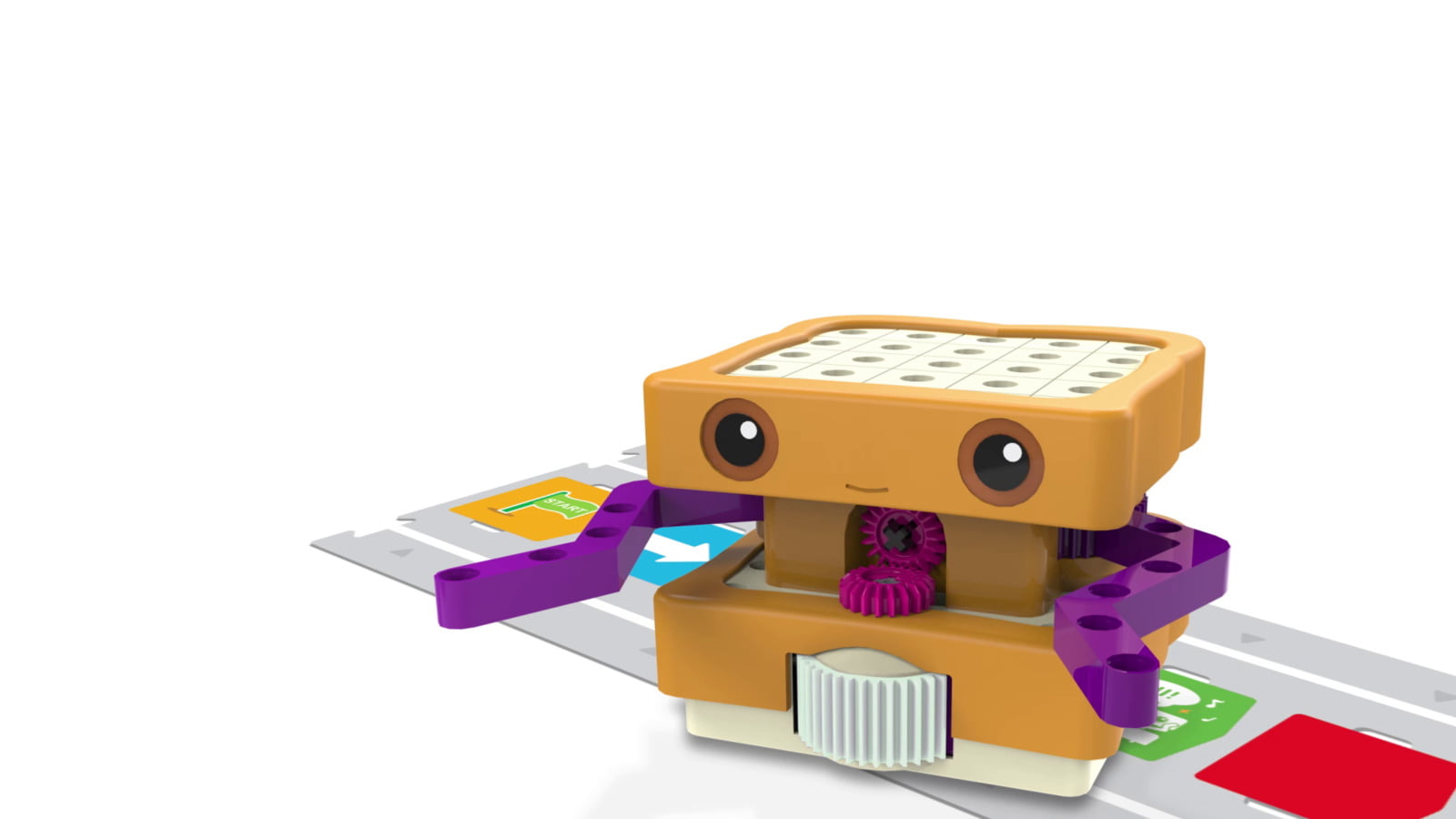
This cute sandwich robot teaches algorithmic thinking and develops STEM skills in pre-school children. It does not require the use of a tablet or computer for programming. Codes are simply created with a series of command cards that consist the algorithmic “path”. On the track, the robot moves in different directions, activates mechanisms, turns on the LED lights, plays sounds and responds to different action cards.
Kids First Coding & Robotics also teaches science, engineering and problem-solving skills through a course of study. For this reason, Kids First Coding & Robotics was selected by WRO Hellas as the proposed equipment for the first pilot STEAM Kindergarten educational contest: “A Walk in My City,” where preschool children will make their first algorithm and present their city in a simple way, while developing their artistic and social skills.
Chapters
Chapte r 1: Introduction, basic functions
Chapter 2: Algorithms
Chapter 3: Coding
Chapter 4: Basic constructions
Chapter 5: Connection to the WRO Hellas contest